



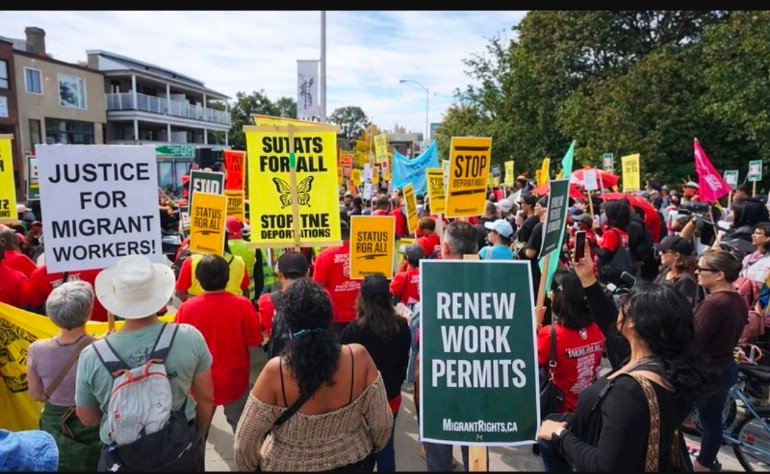
Toronto: Thousands of migrants, international students, refugees and undocumented people held protests in several Canadian cities on Sunday, ahead of the opening of the new session of Parliament. The protesters called for a pathway to permanent residency (PR) for migrants already living in Canada and demanded a halt to deportations.
In Toronto, the march began at 2 pm from Christie Pits Park and ended at Dufferin Grove Park. Toronto Police said around 600 people participated. The Migrant Workers Alliance for Change said 11 marches were held across the country on the issue.
Organisation leader Syrom Roh said around 1.7 million people are currently living in Canada on temporary work or study permits. According to her, many are working in agriculture, childcare, elder care and other essential services but face uncertainty over their future.
Bikramjit Singh, who came to Canada from India as an international student in 2019, said uncertainty over immigration status could make workers more vulnerable to exploitation. He said he is currently on a closed work permit and does not see a clear pathway to PR.
Protesters also raised concerns over high rents, the rising cost of living and job insecurity.
An undocumented migrant woman from Uganda, who identified herself as “Jane” for safety reasons, said she had been living in Canada without legal documentation for six years. She said she wanted a good job with equal rights and an opportunity to reunite with her family.
The protests took place as the federal government focuses on reducing the number of temporary residents and linking immigration levels to housing, public services and labour-market capacity.
Under the 2026-2028 Immigration Levels Plan, the government has set a target of admitting 380,000 new permanent residents each year. It has also announced plans to transition up to 33,000 temporary workers to permanent residency in 2026 and 2027.
The developments highlight the differing positions between the government’s focus on managing immigration numbers and migrant-rights organisations’ demand for permanent status for people already living in Canada.