












































“Supports STT Hike, Calls for Zero LTCG to on Equities”: Raghav Chadha
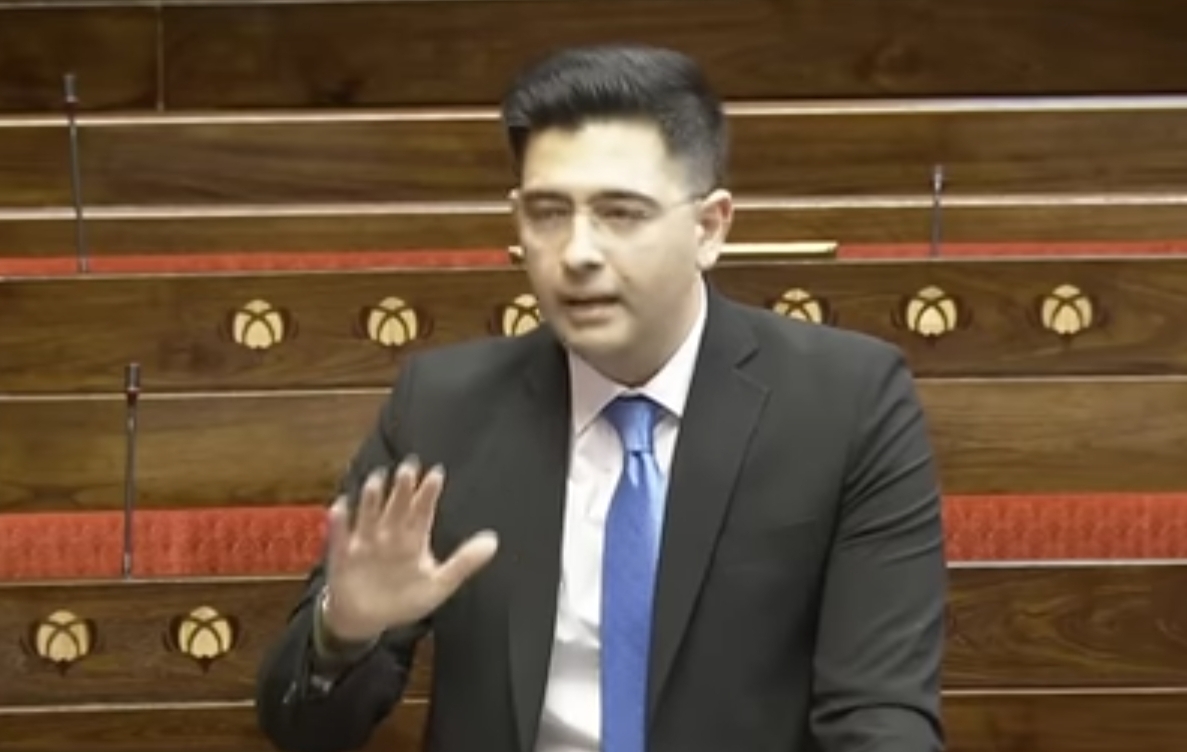
New Delhi: Hon’ble Rajya Sabha MP Raghav Chadha today delivered a comprehensive, data-backed and objective analysis of the Union Budget in Parliament. Moving beyond routine political praise or criticism, Shri Chadha structured his intervention under the theme “The Good, The Bad and The Way Forward”, offering constructive criticism and reform-oriented suggestions aimed at strengthening India’s economic fundamentals, protecting investors, and safeguarding the middle class.
THE GOOD
1. STT Increase on Derivative Trading
Shri Chadha welcomed the increase in Securities Transaction Tax (STT) on derivative trading, stating that while markets reacted negatively in the short term, the measure could help curb excessive speculative activity. He pointed out that nearly 90% of retail investors lose money in Futures & Options, turning it into a gambling-like activity rather than genuine investment. Higher STT, he said, could discourage reckless speculation and protect small investors.
However, he reminded that STT was introduced when Long-Term Capital Gains (LTCG) tax on equities was zero and was meant to be a simple upfront levy irrespective of profit or loss. With both STT and LTCG now in place, investors are being disincentivised. Shri Chadha urged the government to make LTCG on equities nil for individual investors, citing global examples such as Switzerland, Singapore, UAE, Hong Kong, New Zealand, Qatar and Malaysia, where long-term equity gains are largely tax-free.
Shri Chadha reiterated his demand to abolish LTCG tax on equities for individual investors, arguing that it would boost household wealth, reduce speculative trading, and channel savings from gold and real estate into productive assets.
2. Increase in Capital Expenditure: Our Infrastructure Multiplier
Shri Chadha praised the substantial rise in capital expenditure, which has increased from about ₹3 lakh crore in FY 2018–19 to nearly ₹12 lakh crore, amounting to approximately 4.4% of GDP. He described this as a positive shift towards asset creation with a strong multiplier effect on growth, employment and productivity.
At the same time, he stressed that the government should present a clear five-year sector-wise capex roadmap, detailing where and how this expenditure will be deployed, so that the private sector can align its investments and amplify economic impact.
3. Relative Restraint: Election-Driven Budget Announcements
Acknowledging a departure from past practices, Shri Chadha noted that the Budget speech showed relative restraint in election-bound announcements. He remarked that Budget speeches often reveal poll priorities through targeted schemes, and appreciated the restraint exercised this time.
4. Enhanced NRI Investment Limits
Shri Chadha welcomed the enhancement of NRI investment limits in Indian equity markets, noting that the move could unlock investments from India’s 32 million-strong NRI community. He pointed out that this step came after foreign portfolio investors withdrew nearly USD 23 billion in the previous financial year. While the measure is positive, he urged the government to address the structural reasons behind continued foreign investor exits, rather than relying solely on NRI inflows.
THE BAD
1. Debt-to-GDP Crisis: Slow Motion Fiscal Collapse
Shri Chadha expressed serious concern over changes in the debt-to-GDP framework. He explained that earlier fiscal rules capped fresh borrowing at around 3% of GDP, whereas the new approach allows borrowing as long as total debt remains under 50% of GDP. This, he warned, enables higher borrowing through optimistic GDP growth assumptions — the so-called denominator effect.
He further highlighted that the government’s stated 56.1% debt-to-GDP ratio does not account for significant off-balance-sheet liabilities, including FCI bonds, oil marketing company bonds, fertilizer dues, NHAI borrowings and other quasi-fiscal instruments and in reality, it is 59.7% with hidden debt of Rs. 17 lakh crores. He urged the government to focus on reducing debt, not redefining fiscal benchmarks.
2. No Income Tax Slab Revision
Shri Chadha termed the absence of income tax slab changes a major disappointment for the salaried middle class. With inflation hovering around 6.8% and wages largely stagnant, expectations of tax relief remained unmet. He demanded that the standard deduction be increased from ₹75,000 to ₹1.5 lakh to provide immediate relief to salaried taxpayers.
3. Middle Class Bearing the Maximum Tax Burden
Highlighting a structural shift, Shri Chadha pointed out that personal income tax collections (around ₹11 lakh crore) have now surpassed corporate income tax collections (around ₹9.8 lakh crore) for the first time. Despite this, the middle class continues to face rising living costs — education up by 8%, healthcare by 9%, rent by 7%, food by 6% and transport by 5% in the last year. He warned that the middle class is being squeezed between the rich and the poor, without adequate policy support.
4. Low Health Budget Allocation: A Structural Failure
Shri Chadha flagged the low allocation to public healthcare as deeply concerning. India currently spends only about 2% of total government expenditure on health, translating to roughly 0.5% of GDP, far below the National Health Policy 2017 target of 2.5% of GDP. He contrasted this with countries like the US (18%), Germany (13%), UK (12%) and Japan (10%), and warned that underfunded public hospitals and costly private healthcare are pushing millions of Indians into poverty every year. Shri Chadha called for a substantial increase in healthcare spending and advocated a “One Nation, One Medical Treatment” vision to ensure equitable, quality healthcare for all citizens, irrespective of income or location
THE WAY FORWARD
1. Blockchain-Based Land and Property Registry
As a major governance reform, Shri Chadha proposed placing all land and property records on a blockchain-based digital registry, beginning with major states, metros and Tier-2 cities. A transparent, time-stamped and tamper-proof system, he said, would reduce disputes, curb fraud, and improve ease of doing business.
Shri Chadha presented a striking international comparison to demonstrate how modern land record systems dramatically improve efficiency and reduce disputes. He noted that Sweden, which has used a blockchain-based property record system since 2018, completes real estate transaction verification in just one day, with costs at around 0.2% of transaction cost and a dispute rate of only 2%. Georgia, an early adopter since 2016, verifies property transactions in about 3 hours, charges a flat fee of roughly $50, and has reduced disputes to around 1%. In Dubai (UAE), where blockchain has been integrated into land records since 2020, verification can happen in as little as 10 minutes, transaction costs are about 0.5%, and disputes have fallen to less than 1%.
In contrast, India’s largely paper-based and partially digital system often takes two to six months for verification, involves high transaction costs of 6–8%, and faces a staggering dispute rate of nearly 48%. Chadha emphasized that this gap shows how adopting a national blockchain-powered land registry could sharply cut delays, lower costs, and drastically reduce property disputes in India.
2. Inflation linked Salary Revision Act: Wage Indexation Law
Shri Raghav Chadha proposed an Inflation-Linked Salary Revision Act to mandate wage indexation to inflation, arguing that between FY18 and FY26, real wages of salaried workers declined by 16%, showing incomes have failed to keep pace with rising prices. He called for a statutory formula to ensure automatic inflation-based wage adjustments across corporates, factories, and gig workers, noting that while government employees receive dearness allowance and pay commission benefits, nearly 85% of India’s formal workforce has no statutory inflation protection, leaving wage growth largely to employer discretion.
To underline feasibility, he cited global models: the United States’ Cost of Living Adjustment (COLA) system provides automatic annual revisions covering about 62 million beneficiaries; Germany revises wages through collective bargaining agreements typically every 18–24 months, benefiting roughly 3.9 million manufacturing workers; Japan’s Shunto wage negotiation system ensures annual wage revisions for around 5.6 million unionized workers; and Belgium mandates automatic wage indexation by law, leading to quarterly adjustments. Chadha argued that adopting a structured indexation framework would protect purchasing power, stabilize consumption, and provide predictable income security for India’s working population.
3. State CAPEX: Matching Funding by Centre
Shri Chadha urged the Centre to provide ₹1.5 lakh crore over five years as matching capital expenditure grants to states, not loans. He argued that current borrowing caps and conditional lending restrict state infrastructure investment. Grant-based support would allow states to expand roads, irrigation, power networks, sanitation, drinking water, and urban infrastructure without balance-sheet stress. He emphasized that capital expenditure has a 2–3x GDP multiplier over 3–5 years, strengthens cooperative federalism, creates jobs, and transforms states into asset builders rather than borrowers.
4. Regulate the VDAs as an asset class
Shri Chadha proposal sought to formally recognize Virtual Digital Assets (VDAs) such as crypto and stablecoins as a regulated asset class. He highlighted the policy contradiction where India taxes VDAs at 30% plus 1% TDS but lacks clear legal classification, investor protection, or dedicated AML norms. As a result, ₹4.8 lakh crore in VDA trading has moved offshore, 73% of Indian crypto trading volume in FY25 shifted to foreign exchanges, and around 180 startups relocated abroad, while 12 crore Indian users invest through overseas platforms. He argued that strong domestic regulation — not prohibition — would bring activity onshore, improve compliance, protect investors, and potentially add ₹15,000–20,000 crore in annual tax revenue, emphasizing that “regulation is protection; prohibition is not.”
Concluding his intervention, Shri Chadha emphasized that a Union Budget must balance growth with fiscal responsibility, protect the middle class, encourage long-term investment, and strengthen public services. He urged the government to view economic policy as a long-term nation-building exercise rather than a short-term political tool.