
















































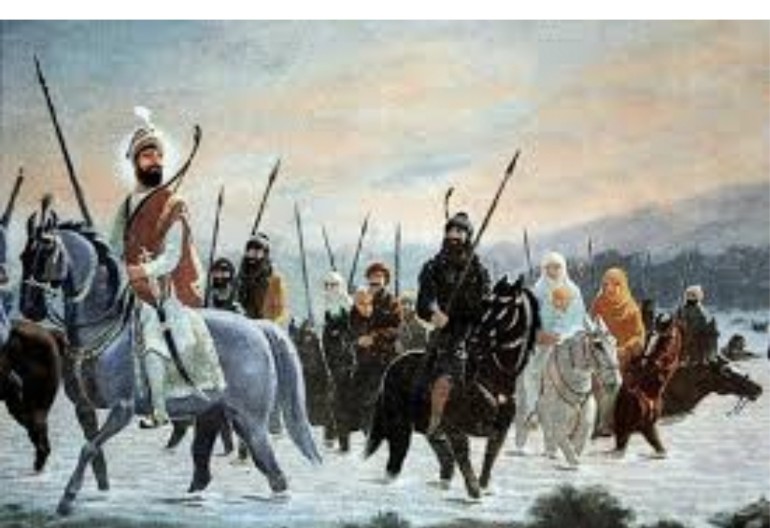
Chandigarh: After leaving Anandpur Sahib, assurances given to Sri Guru Gobind Singh by the Mughal authorities and allied hill rulers were violated, leading to a sudden military attack on the Guru’s convoy. Amid heavy fighting and confusion, the Guru, along with his Sikhs and family members, was compelled to cross the flooded Sarsa River, which was flowing at high levels at the time.
During the crossing, the Guru’s family was separated. Mata Gujri, accompanied by the Guru’s two younger sons—Sahibzada Zorawar Singh (9) and Sahibzada Fateh Singh (7)—became separated from Guru Gobind Singh. Holding their grandmother’s hands, the children reached the confluence where the Sarsa merges with the Sutlej River.
Historical Sikh accounts mention that at this location, a local water carrier named Kuma, described as a God-fearing man sympathetic to the Guru, provided temporary shelter to Mata Gujri and the two children in his hut, where they stayed overnight.
Subsequently, they encountered Gangu, a Brahmin who had earlier served as a cook in the Guru’s household. Gangu took Mata Gujri and the two Sahibzadas to his village, Saheri, near Morinda. However, upon noticing a pouch of coins carried by Mata Gujri for sustenance during the journey, Gangu allegedly stole it during the night.
When confronted, he denied the act and falsely claimed that a thief had taken the money. Mata Gujri reportedly told him that she had seen him taking the pouch and said he could keep it if he was in need, but should not resort to falsehood. Fearing exposure and driven by greed, Gangu raised a false alarm and later informed the local authorities, hoping to gain a reward.
Acting on the information, the Morinda official took Mata Gujri and the two Sahibzadas into custody. They were detained overnight at Morinda before being handed over to the Mughal administration at Sirhind the following day.
This incident marks a crucial stage in Sikh history, preceding the martyrdom of the younger Sahibzadas, and remains a powerful reminder of betrayal, resilience, and sacrifice during a turbulent phase of Mughal rule.