
























New Delhi: The Government of India has notified the Prime Minister – Road Accident Victims’ Hospitalisation and Assured Treatment (PM-RAHAT) Scheme under Section 162 of the Motor Vehicles Act, 1988, to provide immediate medical assistance to victims of road accidents.
The scheme was formally notified through S.O. 2015(E) dated May 5, 2025, while detailed guidelines outlining the implementation process, stakeholder responsibilities and standard operating procedures were issued through S.O. 2489(E) dated June 4, 2025.
Prime Minister Narendra Modi launched the scheme on February 13, 2026, and it was officially named the PM-RAHAT Scheme through S.O. 952(E) dated February 19, 2026.
Key features of the scheme
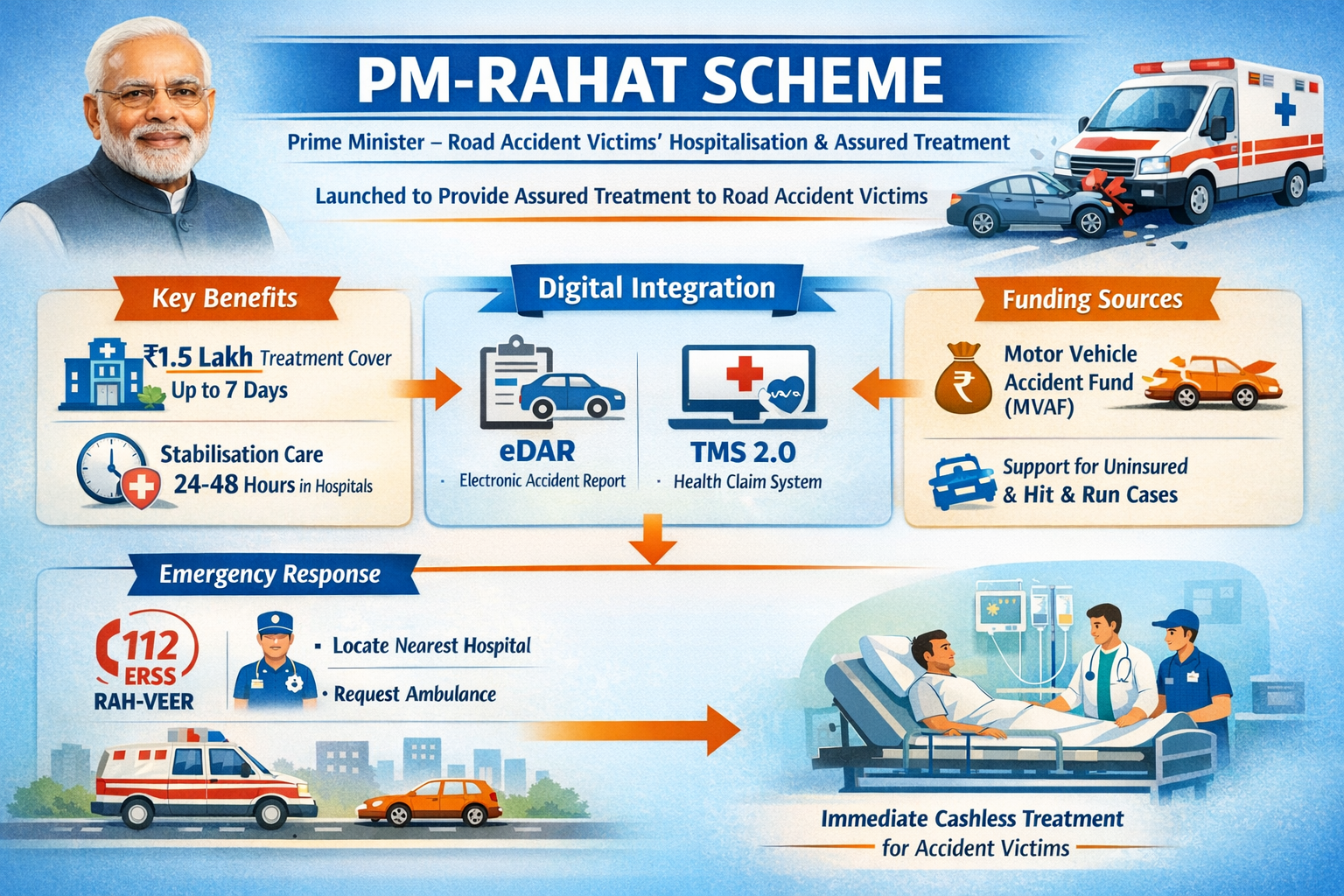
Under the scheme, road accident victims will receive cashless treatment coverage of up to ₹1.5 lakh per person for a maximum period of seven days from the date of the accident, regardless of the type of road where the accident occurs. The benefit applies to all victims involved in accidents caused by motor vehicles.
Victims will receive stabilisation treatment for up to 24 hours in non-life-threatening cases and up to 48 hours in life-threatening situations at designated hospitals, depending on the response from police authorities.
The PM-RAHAT Scheme has been given statutory priority over any other central or state government schemes, ensuring that accident victims receive immediate treatment without administrative delays.
Digital integration for implementation
The scheme has been implemented through the integration of two existing digital platforms: eDAR (Electronic Detailed Accident Report) used by police to record accident details, and TMS 2.0 (Transaction Management System) of the National Health Authority, used by hospitals for treatment records, claim submissions and payment processing.
Hospitals will be reimbursed through the Motor Vehicle Accident Fund (MVAF). The fund is supported by contributions from general insurance companies in cases where the offending vehicle is insured, while the government provides budgetary support for uninsured or hit-and-run cases.
Emergency support and hospital access
The scheme is also linked with the 112 Emergency Response Support System (ERSS). Through this system, victims or Good Samaritans—referred to as RAH-VEER—can locate the nearest designated hospital, request an ambulance or access other emergency assistance.
Once a victim is admitted to a designated hospital, treatment must begin immediately based on Health Benefit Packages developed by the National Health Authority.